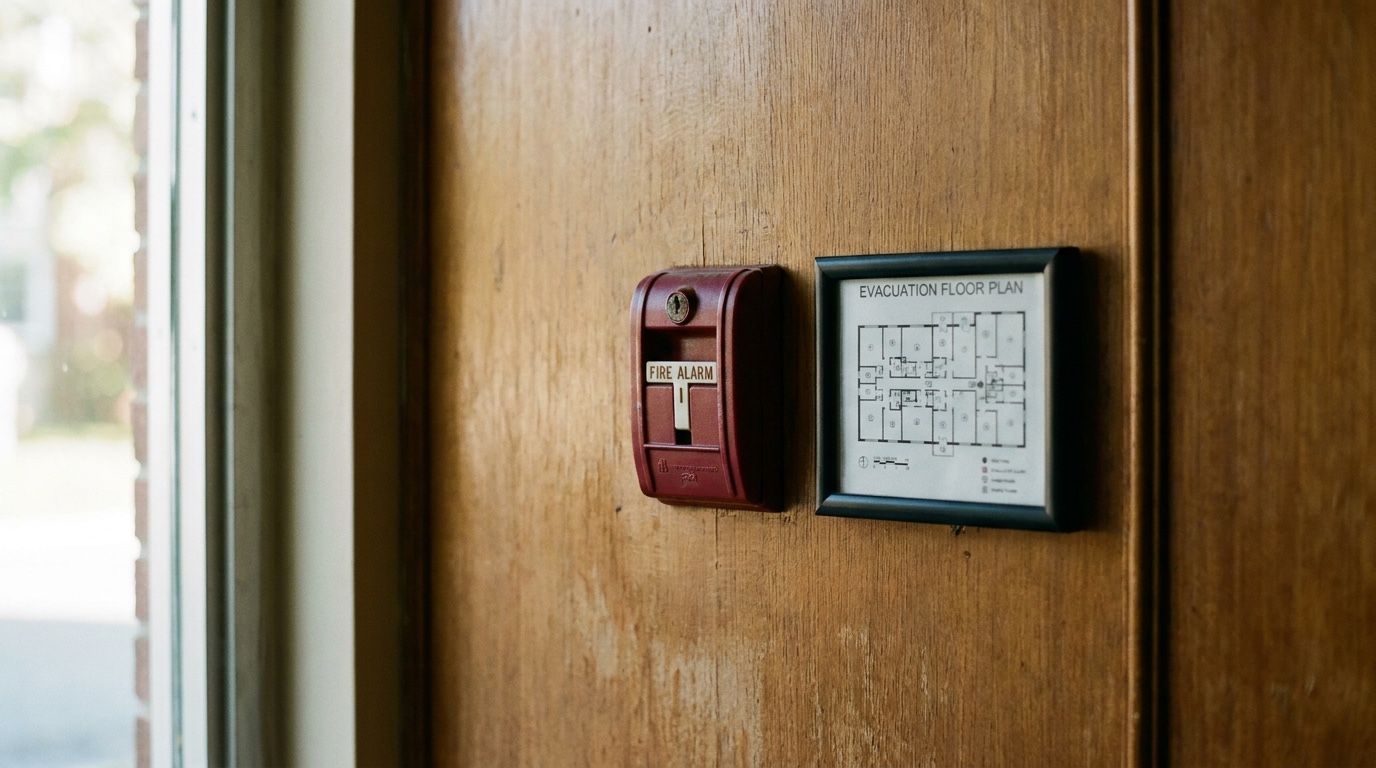
A strata fire safety plan is mandatory in BC for every building the Building Code requires to have a fire alarm system, which captures most condo stratas. Since August 1, 2024, the Fire Safety Act backs that duty with administrative penalties of up to $50,000 for a corporation. This guide covers who needs a plan, what it must contain, what it costs, which fund pays, and where fire safety sits in the wider strata assessment stack. We built it from primary sources: the Fire Code text, the Act itself, VISOA and CHOA bulletins, and municipal fee schedules.
Key takeaways
- The trigger: A fire alarm system. Section 2.8 of the BC Fire Code requires a plan in every building that must have one; most condo stratas are in, townhouse-only stratas usually out.
- The clock: Review the plan at intervals of no more than 12 months.
- The enforcement: The Fire Safety Act, in force August 1, 2024, allows administrative penalties up to $50,000 for a corporation and fines up to $250,000 on conviction.
- The cost: Several hundred to several thousand dollars to prepare, plus municipal fees. Fire inspections, meanwhile, come from the operating fund, not the CRF.
- The failure mode: An obsolete alarm panel that dies puts the building on 24-hour firewatch at roughly $25,200 plus taxes per month.
The council carries the legal duty. The technical work is contractable. Confusing those two facts is how buildings end up paying for firewatch.
Who needs a fire safety plan in BC
Does my strata need a fire safety plan?
If the BC Building Code requires your building to have a fire alarm system, your strata must keep a fire safety plan. A fire safety plan is the emergency-planning document required by Section 2.8 of the BC Fire Code, Division B, prepared together with your local fire department. The Fire Code, notably, applies to existing buildings, not just new construction.
The trigger is the alarm system, not the strata title. A 40-unit Vancouver lowrise with interior corridors and a common alarm panel, for example, needs a plan, appointed supervisory staff, and a documented review every 12 months. In contrast, a 14-unit bare-land townhouse strata with no common alarm system generally does not. VISOA’s February 2024 bulletin treats townhouse fire systems as their own category for this reason. Misclassify in one direction and you pay for compliance you do not owe; in the other, you meet a fire inspector with nothing to show.
It is not settled whether a row of self-contained townhomes sits inside the Fire Safety Act’s definition of a public building. Accordingly, confirm with your fire department before commissioning a plan you may not need.
What the plan must contain, and the 12-month clock
The plan is not an escape map taped to a wall. In fact, under Section 2.8 it has seven required parts:
- Emergency procedures: sounding the alarm, notifying the fire department, instructing and evacuating occupants (with provisions for people who need assistance), and confining or extinguishing the fire.
- Appointment and organization of supervisory staff.
- Training for those staff.
- Diagrams of the building’s fire emergency systems.
- The holding of fire drills.
- Control of fire hazards.
- Inspection and maintenance of the building’s fire safety facilities.
The plan must be reviewed at intervals of no more than 12 months, so it reflects changes in the building’s use and characteristics. It stays in the building for fire department reference, with emergency procedures posted on each floor area.
Fire drills, likewise, follow the same rhythm, but the duty is narrower than councils assume: drills are for supervisory staff, every 12 months, or every 2 months in high buildings within Building Code Subsection 3.2.6, roughly meaning high-rises. The Code does not demand a bimonthly all-resident evacuation of your three-storey walk-up.
What the Fire Safety Act changed in August 2024
The Fire Safety Act is the provincial statute that replaced the Fire Services Act on August 1, 2024, the first substantial rewrite since 1979. Municipalities now run risk-based compliance monitoring; regional districts, conversely, stay complaint-based.
In VISOA’s April 2025 webinar, fire consultant Kathleen Nicholas explained that residential occupancies carry a high risk level under the risk-analysis regulation, because people sleep there overnight. As a result, that generally points toward annual fire department inspection, with each municipality setting its own frequency through local bylaws.
The penalties are the part councils should read twice. Under section 33 of the Act, the fire commissioner can levy administrative monetary penalties of up to $25,000 for an individual and $50,000 for a corporation. On conviction under section 36, the ceiling rises to $250,000 for a corporation. Section 46 targets stratas directly: a fire inspector’s order that applies to six or more strata lots can be served on the strata corporation instead of on each owner, and the corporation is deemed the owner and must comply.
An unread order sitting in the manager’s inbox is a corporate liability, not an administrative slip.
Do strata councils have to sign an annual compliance declaration?
Not yet, and depending on your municipality, possibly never. A fire safety assessment under section 21 is a self-assessment a municipality can require of a public building’s owner; skip it and the municipality can inspect instead. As of April 2025, however, the commissioner’s office was still developing the manual and declaration form. Ask your fire department what its system requires.
Grandfathering, obsolete panels, and the $25,200 firewatch
The Act applies to every building regardless of construction date; nevertheless, it does not force retroactive upgrades. Equipment installed under an earlier code stays compliant while it is “operating as originally designed and intended,” as Nicholas put it in the VISOA webinar.
Grandfathering ends the day the panel fails or replacement parts stop existing.
That is the budget risk hiding in your annual inspection report. When the report starts recommending a fire alarm upgrade, it is flagging a panel the manufacturer no longer supports. If an obsolete panel fails outright, the building goes on 24-hour firewatch until a replacement runs: about $35 an hour, or roughly $25,200 plus taxes per month, per the webinar’s figures. If a replacement takes three months to source, that is north of $75,000 in firewatch, none of it budgeted. Councils that treat the upgrade recommendation as a depreciation-report line item, on the other hand, replace the panel on their own schedule.
Who is responsible for what
Two lines of law converge on council. Under section 72 of the Strata Property Act, the corporation must repair and maintain common property, which covers the alarm panel, sprinklers, emergency lighting, and extinguishers. Division C of the Fire Code, similarly, places responsibility for carrying out the Code on the building owner or the owner’s agent, a point Richmond Fire-Rescue makes to strata councils.
In-suite smoke alarms, however, run the other way. Unless your bylaws say otherwise, the owner of the strata lot maintains and tests them, per VISOA’s February 2024 bulletin. In 2022, in fact, only 45% of BC structure fires reported to the fire commissioner had a working smoke alarm.
Documentation is council’s own job, and CHOA’s July 2025 Condo Smarts bulletin 300-1150 by Tony Gioventu sets the standard. Record fire incidents, testing, drills, false alarms, and training in council minutes. Keep a documented list of residents who need evacuation assistance where responders can reach it. Then confirm with your insurance broker that the strata is meeting its Fire Code obligations, because policies require owners to keep fire safety systems operational. Thin documentation surfaces twice: as an inspection finding, then as an insurer’s coverage question after a loss.
What it costs, and which fund pays
From our research, no BC provider publishes a fixed strata price for preparing a fire safety plan. Otis Fire Protection’s 2026 price guide puts professional preparation at several hundred to several thousand dollars depending on building complexity, with municipal review fees on top.
Municipal rules move the number. In Vancouver, for example, Fire By-law 14419 requires a plan in every building with a fire alarm system, and an ASTTBC-certified technician must inspect and tag sprinklers, standpipes, fire alarms, emergency lighting, and extinguishers annually. The third false alarm in a calendar year draws a $216 fee.
In the District of North Vancouver, meanwhile, the plan must come from an approved fire safety planner, pass review by a public safety officer, and ship with a pre-incident plan. The District charges $184 plus $9.20 GST for the first two hours of review.
Which fund pays is settled at the tribunal. In Greene v. The Owners, Strata Plan KAS 1244, 2021 BCCRT 291, as summarized in VISOA’s November 2021 bulletin, the CRT held that a $500 fire inspection could not be paid from the contingency reserve fund because fire inspections recur annually. The recurring stack, therefore, belongs in the operating budget. Budget it once a year and the CRT question never arises.
Where fire safety sits in the assessment stack
Fire safety is one of three compliance clocks now running on BC stratas, and the only one that never stops. Depreciation reports, for instance, run on a five-year cycle for stratas with five or more lots; the deferral vote was abolished on July 1, 2024. Stratas in Metro Vancouver, the Fraser Valley, and the Capital Regional District needed a current report by July 1, 2026, while the rest of BC has until July 1, 2027. Our depreciation report guide covers the cycle, and the obsolete-panel risk above is exactly what that report should be pricing.
Electrical planning reports under section 94.1 of the SPA are due December 31, 2026 in those same regions and December 31, 2028 everywhere else, notably with no waiver mechanism. Our EV charging guide explains what that report covers.
From our research into VISOA and CHOA programming, the consistent message is that councils carry the legal duty but can, and should, contract the technical work. A firm serving your building properly tracks every row of the calendar below without being asked; if yours is not, that is a measurable service gap. VISOA’s free 30-minute webinar is the best half-hour a council member can spend on the Act, and CHOA’s bulletins 300-1150 and 200-084 cover documentation duties and wider emergency planning.
The receipt: the fire-safety compliance calendar
Screenshot this table and bring it to your next council meeting. Specifically, ask your manager which rows have a current, dated record on file.
| What | How often | Standard or authority | Who signs off |
|---|---|---|---|
| Fire safety plan review | Every 12 months | BC Fire Code, Div. B, s. 2.8 | Council with the plan preparer |
| Fire drills (supervisory staff) | Every 12 months; every 2 months in high buildings | BC Fire Code, s. 2.8 | Supervisory staff, recorded in minutes |
| Fire alarm inspection | Annual | CAN/ULC-S536 | Certified technician; ASTTBC tag in Vancouver |
| In-suite smoke alarms | Test monthly; batteries annually; replace at 10 years | CAN/ULC-S552; VISOA guidance | Owner, unless bylaws reassign |
| Integrated systems testing | Year 1, year 2, then every 5 years | ULC S1001 | Testing contractor; widely missed |
| Sprinklers and standpipes | Per NFPA 25; annual in Vancouver | NFPA 25 | Certified technician |
| Portable extinguishers | Per NFPA 10; annual in Vancouver | NFPA 10 | Certified technician |
| Generator and emergency lighting power | Per standard | CSA C282 | Certified technician |
| Records retention | 2 most recent years in the plan binder; verification reports for the life of the system | BC Fire Code; Strata Property Regulation, per VISOA | Council and manager |
| Depreciation report | Every 5 years | SPA; gov.bc.ca deadlines | Designated professional |
| Electrical planning report | Once, by Dec. 31, 2026 or Dec. 31, 2028 | SPA s. 94.1 | Qualified preparer |
| Insurance confirmation of fire-system compliance | At policy renewal (recommended) | CHOA bulletin 300-1150 | Council with broker |
A council that can produce a dated record for every row is inspection-ready. A council that cannot is relying on nobody asking.
Related reading for your council
- Strata council duties in BC — where fire-safety documentation fits among council’s other legal obligations.
- The strata management contract checklist — confirm compliance tracking is actually in your firm’s scope.
- The BC depreciation report deadline guide — price the alarm-panel replacement before it prices itself.
Frequently asked questions
- Does my strata need a fire safety plan?
- If the BC Building Code requires your building to have a fire alarm system, yes. Section 2.8 of the BC Fire Code, Division B, requires a fire safety plan for every such building, which captures most multi-unit condo stratas. Townhouse-only stratas without a common alarm system generally fall outside the requirement, but confirm the classification with your local fire department rather than assuming.
- How often must a fire safety plan be reviewed or updated?
- At intervals of no more than 12 months, under Section 2.8 of the BC Fire Code. The review must account for changes in the building's use and other characteristics, and the plan must be kept in the building for fire department reference, with emergency procedures posted on each floor area.
- Who is responsible for smoke alarms in a strata, the owner or the strata?
- For in-suite smoke alarms, the owner of the strata lot is responsible for maintenance and testing unless the bylaws say otherwise, per VISOA's February 2024 guidance: test monthly, replace batteries annually, and replace the unit 10 years from its manufacture date. Common-property fire systems remain the corporation's duty under section 72 of the Strata Property Act.
- How much does a fire safety plan cost in BC?
- No BC provider publishes a fixed strata price. Otis Fire Protection's 2026 price guide puts professional preparation at several hundred to several thousand dollars depending on building complexity, with municipal fees on top. The District of North Vancouver, for example, charges $184 plus GST for the first two hours of plan review.
- Do strata councils have to sign an annual declaration that their building complies with the Fire Safety Act?
- Not yet, and possibly never, depending on your municipality. Section 21 of the Fire Safety Act lets a municipality require a fire safety assessment of a public building, but the Office of the Fire Commissioner was still developing the self-assessment manual and declaration form as of April 2025. Ask your local fire department what its risk-based monitoring system requires.
- Are fire drills mandatory in BC apartment buildings?
- Yes, but the duty is narrower than most councils assume. Under Section 2.8 of the BC Fire Code, fire drills are held for supervisory staff at intervals of no more than 12 months, and every 2 months in high buildings within the scope of Building Code Subsection 3.2.6. The Code does not require bimonthly all-resident evacuation drills in an ordinary strata.