A strata wind-up in BC needs two things before a developer can buy your building. Owners holding 80% of all the votes must approve it (Strata Property Act s.277), and for a strata of five or more lots, the BC Supreme Court must confirm that vote (s.278.1). A letter offering to buy every unit binds no one, and nothing council writes back should either.
This guide is for the council that just opened that letter: the first month, the law, and what BC courts have done with contested wind-ups. The advice council relies on should come from people who work for the strata, not the buyer.
80% of all the votes, not 80% of the room.
Council’s first month after the letter
- Table the letter and send a copy to every owner. They’ll hear about it anyway, and it’s better from council.
- Ask each council member to disclose any interest beyond their own unit’s share, such as a side offer for their unit or a tie to the buyer or a broker. A member whose interest could conflict with their duty must disclose it, abstain and leave the room for that item (Strata Property Act s.32, current to October 20, 2026). If they don’t, a court that finds a contract unfair can set it aside or order any profit repaid (s.33).
- Acknowledge the letter in writing, and say nothing else. The template is below.
- Warn owners they may be approached one by one. At Barclay Terrace in Vancouver, two developer-affiliated companies bought 34 of 36 units before the vote (2018 BCSC 390, paras. 3 and 4). Each unit sold hands the buyer a vote. Don’t give the buyer the owner list.
- Hold an information meeting, then a general meeting where owners decide whether to explore a sale and pay for independent advice. The Province advises councils to proceed only once owners have formally given direction (termination guide). Notice rules are in our SGM checklist.
- Keep the maintenance plan, insurance and building security running. In a 2023 CHOA bulletin, an owner described a strata that had put off its roof and a boiler since 2019 while exploring a sale. It now expected a levy of about $50,000 a unit. The reply warned that few wind-ups then paid a premium and that buyers often wanted two to three years to close (CHOA bulletin 300-1048, June 22, 2023).
Reply to the developer
[Date]

Re: Your letter of [date] about The Owners, Strata Plan [number]

Council has received your letter and will share it with the owners.
Any decision about a sale belongs to the owners at a general meeting.
Council will contact you if owners decide to take a next step.
Until then, please direct any correspondence to council, not to
individual owners.

[Name], on behalf of the strata council
What council shouldn’t sign yet
Until owners have given direction at a general meeting, we wouldn’t sign:
- an exclusivity agreement or letter of intent with one developer;
- a broker’s listing agreement, which the Province says the strata’s lawyer should review for the commission and for dual agency (termination guide);
- a confidentiality agreement that stops council telling owners what’s on offer;
- a retainer with a lawyer the buyer chose. If a buyer offers to cover legal costs, the strata should still pick and instruct its own lawyer.
Council members must act honestly and in good faith in the strata’s best interests, with a reasonably prudent person’s care (s.31; more in our council duties guide). We’d want owners’ direction on the record before council commits the strata to anything.
Why developers are writing to older stratas
In late 2023 the legislature passed Bill 47, which made municipalities designate transit-oriented areas around SkyTrain stations, bus exchanges and West Coast Express stations. All 104 areas, in 31 municipalities, are in effect (Province of BC, updated July 22, 2026). Inside them, a municipality can’t reject a rezoning because of its density or height if both are at or under the provincial minimums, and it can’t require residential parking beyond accessible spaces.
Minimum allowable density near a SkyTrain or Canada Line station. Source: Province of BC, TOA distances and densities.
Why developers are writing to older stratas
| Distance from the station | Floor area ratio | Height |
|---|---|---|
| 200 m or less | up to 5.0 | up to 20 storeys |
| 200 m to 400 m | up to 4.0 | up to 12 storeys |
| 400 m to 800 m | up to 3.0 | up to 8 storeys |
Source: Guide sources, checked October 26, 2026. See the Sources section in this guide.
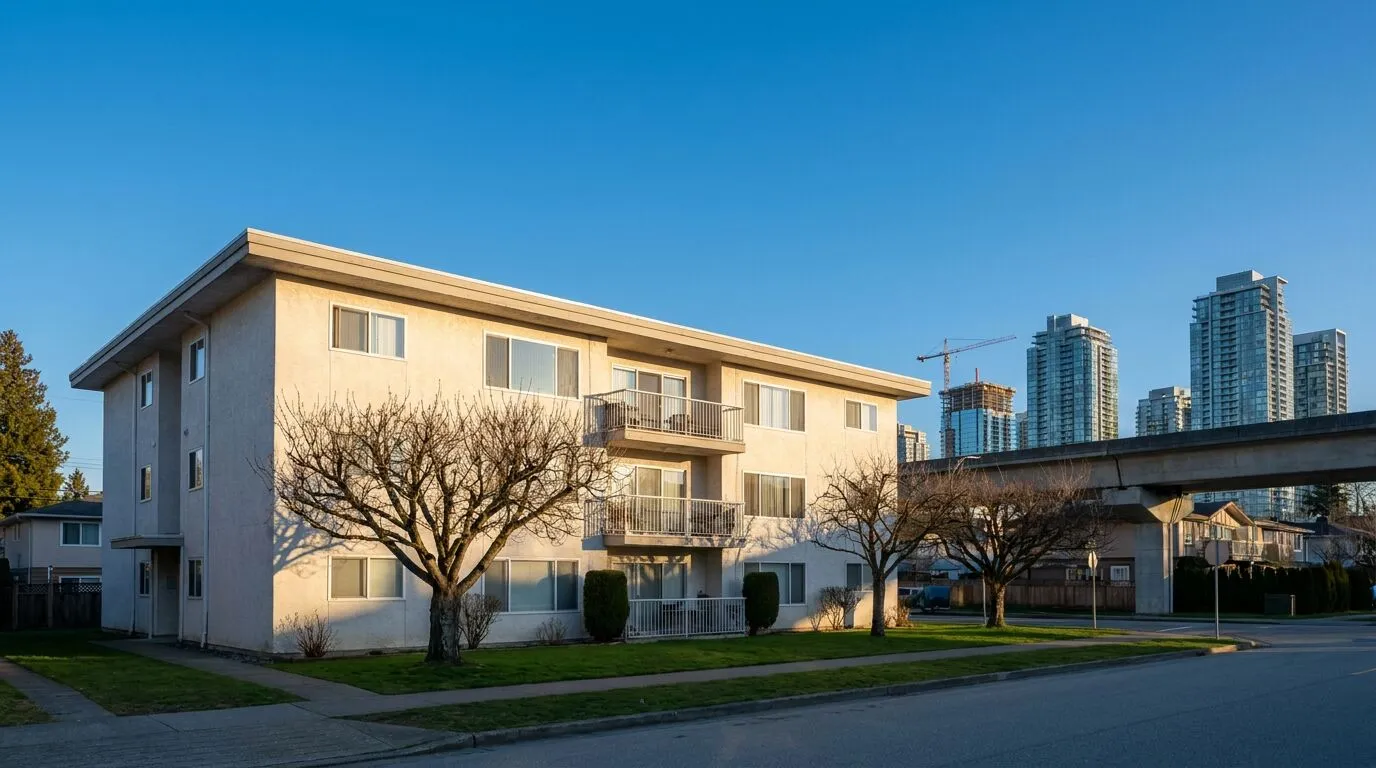
Floor area ratio is a building’s total floor area divided by its lot area. A three-storey walk-up 300 metres from a station sits on land where the city can’t turn down a 12-storey rezoning on height or density alone. It can still refuse for other reasons (TOA policy manual). Expect the offer to depend on that rezoning. A companion law, Bill 44, mostly affects lots zoned for a house or a duplex (Province of BC, updated January 20, 2026).
The building is the other half. The Province’s termination guide notes that some older stratas reach the end of their life cycle, when repairs stop making economic sense or owners can’t pay for them. At Ascott Wynde, a 1977 wood-frame complex in Richmond, a council member used the depreciation report to estimate $4.97 million of repairs over five to seven years. That meant levies of $36,664 to $67,664 a unit, and the owners voted to sell instead (Strata Plan NWS837 (Re), 2018 BCSC 564, para. 7).
Two things cut the other way this fall. BC Assessment’s 2026 values, set at July 1, 2025, showed most Lower Mainland homes changing between 10% down and flat (BC Assessment, January 2, 2026). And BC elected a Conservative majority on October 24 (CBC, October 26, 2026); the transit-area densities sit in regulations that cabinet can amend. We hadn’t seen any announced change when we checked on October 26. If an offer depends on that density, ask your lawyer how the agreement handles a zoning change before closing.
How a strata wind-up works in BC
A wind-up cancels the strata plan and dissolves the strata corporation. An en bloc sale sells every unit and all the common property to one buyer in a single deal. To sell, owners pass a winding-up resolution that cancels the plan, appoints a liquidator, and approves a cost estimate and an interest schedule (s.277).
The liquidator takes title to the whole property, completes the sale and pays out the money. The BC Court of Appeal has described the role as mainly a conduit, and a liquidator doesn’t have to be a professional (2018 BCCA 280, paras. 35 and 37).
The interest schedule lists every owner, lender and creditor, and each owner’s share (s.278). Plans from August 1974 to 2000 usually carry a schedule of interest on destruction, which sets the split (s.278(3)). Newer plans split by each lot’s most recent assessed value over the total, and the Province’s guide says pre-1974 plans use unit entitlement. Pull your strata plan this week and check.
In three of the cases below, council signed a purchase agreement before owners voted, conditional on the vote and the court order. Owners want to know what a sale means for them before they agree to wind up, as the Court of Appeal noted (2018 BCCA 280, para. 34).
Until July 28, 2016, a wind-up needed every owner’s vote. The legislature lowered the bar to 80% of all eligible voters and added court oversight to protect owners who vote no and the lenders holding their mortgages (termination guide).
Votes and approvals at each step of a sale through a liquidator. Source: Strata Property Act, Part 16 and Part 4, current to October 20, 2026.
How a strata wind-up works in BC
| Step | What it takes | Section |
|---|---|---|
| Owners direct council to explore a sale | Majority vote at a general meeting (good practice, not required) | s.27 |
| Pay for a lawyer or appraiser outside the budget | 3/4 vote; without one, council can spend only the lesser of $2,000 and 5% of the year’s operating contribution, unless the bylaws set another limit | ss.96 to 98 |
| Owners with 20% of the votes demand a wind-up meeting | Meeting held within 8 weeks | s.43(3.1) |
| Notice of the wind-up meeting | At least 4 weeks’ written notice with the full resolution; owners can’t waive it | s.45 |
| Winding-up resolution | 80% of all eligible voters | ss.1, 277 |
| Approving the sale itself | 3/4 vote before any disposition, or it’s void; Bel-Ayre’s owners voted on it at the same meeting | s.282 |
| Court confirmation (5 or more lots) | Application within 60 days of the vote | s.278.1 |
| Vesting order | Liquidator applies within 30 days of appointment | s.279 |
| Final accounts | 3/4 vote | s.283 |
Source: Guide sources, checked October 26, 2026. See the Sources section in this guide.
How many owners have to vote yes?
80% of the votes of all eligible voters (s.1). A lot that doesn’t vote yes counts against, so an owner who stays home without sending a proxy is a no. Lenders can’t vote on a winding-up resolution, and the owner votes unless a tenant holds the landlord’s vote (s.54(2)). A bylaw that suspends the votes of owners in arrears doesn’t apply to an 80% vote (s.53(2)). The other votes in the table are 3/4 votes, which count only the votes cast at the meeting.
Yes votes needed, assuming one vote per lot and no Schedule of Voting Rights. Source: our arithmetic on s.1.
How a strata wind-up works in BC
| Lots in the strata | Yes votes needed | No votes or non-votes that defeat it |
|---|---|---|
| 4 | 4 | 1 |
| 5 | 4 | 2 |
| 12 | 10 | 3 |
| 20 | 16 | 5 |
| 42 | 34 | 9 |
| 60 | 48 | 13 |
| 101 | 81 | 21 |
Source: Guide sources, checked October 26, 2026. See the Sources section in this guide.
With four or fewer lots and one vote each, one lot is more than 20% of the votes, so everyone must agree. Those stratas don’t have to ask the court to confirm the vote (s.278.1), though a sale through a liquidator still needs the court’s vesting order (s.279).
What does the court look at before confirming a wind-up?
The judge weighs the owners’ best interests against the risk of significant unfairness to owners, lenders or other creditors (s.278.1(5)). The judge also weighs the risk of significant confusion and uncertainty, both if the vote is confirmed and if it isn’t. Every owner and lender in the interest schedule is served with the application.
We read the seven decisions behind the table below for this guide. Objecting owners carry the onus (2017 BCSC 2386, para. 82), and being forced to move isn’t enough on its own (2018 BCSC 564, para. 63). The paperwork gets read line by line. In 2017 a judge refused an 83.3% vote at Bel-Ayre Villa because the interest schedule left out each lender’s estimated value, a required item (2017 BCSC 1661).
Five BC wind-ups that reached court
We didn’t find a published count of BC strata wind-ups, so we can’t say how often a letter becomes a sale. Every wind-up of five or more lots goes to court, and the decisions with written reasons are the best public record we found.
BC wind-ups decided in court, 2017 to 2025. Source: each judgment, linked.
Five BC wind-ups that reached court
| Building | Units, built | Vote | Price | Outcome |
|---|---|---|---|---|
| The Hampstead, West End, Vancouver | 33, 1988 | 28 of 33, then 27 of 33 at a second meeting called to add the liquidator’s name | $45.25M; lots assessed at $18.37M in 2017 | Confirmed (2017 BCSC 2386); liquidator orders set aside on appeal because the liquidator must apply for them (2018 BCCA 280) |
| Bel-Ayre Villa, Vancouver | 36, 1974 | 30 of 36 (83.3%) | $19M after marketing; broker’s early estimate $14M to $16M | Refused: interest schedule incomplete (2017 BCSC 1661) |
| Barclay Terrace, West End, Vancouver | 36, about 1992 | 34 of 36, all held by two developer-affiliated companies | $78.75M share of a $105M sale with the lots next door | Confirmed (2018 BCSC 390) |
| Ascott Wynde, Richmond | 102, about 1977 | 86 of 102 (84.3%) | $49.8M; lots assessed at $31.21M in 2018 | Confirmed (2018 BCSC 564) |
| Cameray Gardens, Burnaby | 101 | Passed February 2022 | $61M, signed December 2022 | Confirmed June 2022; sale didn’t close (2024 BCSC 405, 2025 BCSC 702) |
Source: Guide sources, checked October 26, 2026. See the Sources section in this guide.
The premium depends on the year you compare. Ascott Wynde owners were told their price was 103% above 2017 assessments but 60% above 2018 ones. The judge found they weren’t misled, partly because the interest schedule showed each unit’s payout (2018 BCSC 564, para. 35). Those deals were struck in 2016 to 2018, in a stronger market.
A vote isn’t a sale. Cameray Gardens owners voted to wind up in February 2022 and approved a $61 million sale in May 2023. Before the December 2023 closing, the buyer raised a lawsuit, tax arrears and leases, and the deal didn’t close (2024 BCSC 405). A week before a court-set new closing date in November 2024, two unidentified people set a fire in one building. The buyer gave notice ending the deal, and the liquidator went to court to hold the $3 million deposit (2025 BCSC 702).
In the three cases with full dates, it took 17 to 26 months from the first owners’ meeting to the court’s decision, before any closing.
Here’s what we’d do
We’d hire a strata lawyer first. Then owners pick a broker after hearing from two or three, and the broker markets the site to every developer, not just the one who wrote. An independent market-value appraisal checks the broker’s pitch number. It all costs money before anyone knows there’s a deal, and the developer who wrote may walk away rather than compete.
Here’s why we’d pay it. In court, the price that held up was the one the market produced. Bel-Ayre’s broker estimated $14 million to $16 million; after marketing, the top bid reached $19 million (2017 BCSC 1661, paras. 14 to 17). Ascott Wynde’s marketing drew six offers, and when objectors called the price too low, the judge found no evidence it was below market (2018 BCSC 564, paras. 14 and 57). If a buyer won’t compete, council has learned something about that buyer.
We’d price the “stay” side at the same time: a current depreciation report from a qualified provider, and an engineer’s assessment or envelope consultant’s estimate if those are the worry.
A worked example
This is a scenario with made-up numbers, not a forecast. Say a 42-lot, 1984 wood-frame low-rise in New Westminster, 300 metres from a SkyTrain station, is offered $29 million. Its plan carries a schedule of interest on destruction, and the lots’ total 2026 assessed value is $19.32 million.
Scenario only; our assumptions are marked. Your real figures come from your strata plan, BC Assessment, your depreciation report and the resolution’s cost estimate.
Here’s what we’d do
| Line | Amount |
|---|---|
| Offer | $29,000,000 |
| Wind-up and sale costs (our assumption: 4% for broker, lawyers, liquidator and court) | −$1,160,000 |
| Left to distribute, before each owner’s mortgage | $27,840,000 |
| One lot’s interest on destruction (our assumption) | 2.5% |
| That lot’s payout, before its mortgage, moving and tax | $696,000 |
| That lot’s 2026 assessed value | $483,000 |
| Repairs due in 10 years, with nothing in the reserve fund for them (our assumption) | $3,360,000 |
| Average levy per lot if owners stay | $80,000 |
Source: Guide sources, checked October 26, 2026. See the Sources section in this guide.
That payout is 44% above the lot’s assessed value. The owner weighs $696,000, less the cost of a comparable home nearby, against keeping a home assessed at $483,000 and paying about $80,000 in levies. The special levy calculator gives each lot’s real share. The vote needs 34 of 42 lots, so nine owners voting no or staying home defeat it.
What each owner should check
Council’s lawyer acts for the strata, not for you, and the Province suggests owners consider their own legal advice (termination guide). Ask your lender about early payout penalties, and check the purchase agreement before signing a new lease. Tax depends on whether the unit was your home or a rental (CRA, principal residence), and BC’s home flipping tax can apply to a unit owned under 730 days (Province of BC). Get your own advice.
If you sell your unit meanwhile, Form B must disclose a passed winding-up resolution, or notice of one not yet voted on (s.59(3)(h.1) and (i); see Form B essentials). If council treats an owner in a significantly unfair way, the Supreme Court can step in (s.164). The Province notes the Civil Resolution Tribunal can also address significantly unfair actions (termination guide).
Who you’ll need
- A strata lawyer, before anything is signed. Our legal services directory lists 19 strata-law firms; 4 name wind-ups or terminations in their published services. We found no published BC fees for this work, so ask two firms for a fixed quote.
- A broker chosen by owners, whose listing agreement your lawyer reviews.
- An appraiser for market value. The 18 firms in our appraisal directory do insurance appraisals, which estimate replacement cost. Ask for a market-value appraisal of the site, from someone with no tie to the buyer or broker.
- A depreciation report provider to price staying (directory); our cost calculator budgets the report.
- An engineer if the report is thin on big items (directory), or a building envelope consultant if the alternative is an envelope rebuild (directory).
- Management help. The Hampstead’s council hired project managers, who sent 13 updates and ran five information meetings (2017 BCSC 2386, para. 36). Ask your manager whether it has run a wind-up; if you’re self-managed, compare management companies.
For your council meeting
Copy this into the agenda package.
Key facts
- A winding-up resolution needs 80% of the votes of all eligible voters; a lot that doesn’t vote yes counts against (SPA ss.1 and 277).
- If our plan was filed between August 1974 and 2000, a schedule of interest on destruction probably sets each owner’s share, not BC Assessment (s.278(3)).
- The meeting needs at least 4 weeks’ written notice, which owners can’t waive (s.45); the Province’s guide reads that as at least 32 days (termination guide).
- With 5 or more lots, the strata must apply to court within 60 days of the vote (s.278.1); owners approve the sale itself by a 3/4 vote (s.282).
- In three BC court cases, it took 17 to 26 months from the first owners’ meeting to the court’s decision (2017 BCSC 1661, 2017 BCSC 2386, 2018 BCSC 564).
- A vote isn’t a sale: the Cameray Gardens deal, approved by owners in 2022 and 2023, still hadn’t closed in February 2025 (2025 BCSC 702).
Questions to ask
For your council meeting
| Ask the developer | Ask your lawyer |
|---|---|
| Which company is buying, and who stands behind the deposit? | Does the letter bind the strata to anything? |
| Which conditions apply (rezoning, financing, due diligence, court order), and when do deposits become non-refundable? | Does our plan have a schedule of interest on destruction? |
| Do owners keep the contingency reserve fund? | What must the interest schedule contain for the court to confirm it? |
| How long can owners stay rent-free, or rent back, after closing? | Which costs come out of the sale before owners are paid? |
| Will you cover the strata’s legal and liquidator costs if the deal dies? | How should the agreement handle a zoning change or damage to the building before closing? |
| Do you, or a related company, own units here? | Does any council member need to declare an interest under s.32? |
Source: Guide sources, checked October 26, 2026. See the Sources section in this guide.
Draft motions. Check the wording with your strata lawyer before the meeting. Resolution 1 needs a 3/4 vote and Resolution 2 a majority vote. Assume the buyer will see anything shared with all owners.
Draft motions for a general meeting
RESOLUTION 1 (3/4 vote)
BE IT RESOLVED THAT The Owners, Strata Plan [number] approve
spending up to $[amount] from the contingency reserve fund to
retain a lawyer who practises strata law and acts only for the
strata corporation, and an appraiser with no tie to [developer]
or any broker, to prepare a market-value appraisal of the strata
lots and common property as a redevelopment site. Council will
share the appraisal, and a summary of the legal advice, with all
owners before any winding-up resolution is put to a vote.

RESOLUTION 2 (majority vote)
BE IT RESOLVED THAT the strata corporation direct council not to
sign any letter of intent, exclusivity agreement, listing
agreement or purchase agreement for the sale of the strata lots
and common property until owners approve the next step at a
general meeting.
Sources
Checked on October 26, 2026. This is general information, not legal advice.
- Strata Property Act, Part 16 (ss.272 to 289), Part 1 (s.1), Part 4 (ss.27, 31 to 33, 43, 45, 53, 54, 59), Part 6 (ss.96 to 98) and Part 10 (s.164), current to October 20, 2026
- Province of BC, Termination (winding up) a strata corporation (January 11, 2021)
- Province of BC, Transit-Oriented Areas (updated July 22, 2026), TOA distances and densities and Provincial Policy Manual: Transit-Oriented Areas
- Province of BC, Small-scale, multi-unit housing (updated January 20, 2026)
- Bill 44, 2023 and Bill 47, 2023
- The Owners, Strata Plan VR2122 v. Wake, 2017 BCSC 2386 (December 22, 2017) and The Owners, Strata Plan VR2122 v. Bradbury, 2018 BCCA 280 (July 10, 2018)
- The Owners, Strata Plan VR 1966, 2017 BCSC 1661 (September 21, 2017)
- The Owners, Strata Plan VR2702 (Re), 2018 BCSC 390 (March 13, 2018)
- Strata Plan NWS837 (Re), 2018 BCSC 564 (April 10, 2018)
- 1038573 B.C. Ltd. v. The Owners, Strata Plan NW289, 2024 BCSC 405 (January 31, 2024) and 2025 BCSC 702 (February 28, 2025)
- CHOA bulletin 300-1048, Failing windup results in major repairs (June 22, 2023)
- BC Assessment, Lower Mainland 2026 property assessments (January 2, 2026)
- CBC News, B.C.’s new Conservative government could hold a shortened fall session (October 26, 2026)
- Canada Revenue Agency, Principal residence (modified February 5, 2026) and Province of BC, BC home flipping tax (updated June 8, 2026)
- Strata Match provider directory, legal services and insurance appraisal listings (data as of October 3, 2026)
Frequently asked questions
How many owners have to vote to wind up a strata in BC?
80% of the votes of all eligible voters, not 80% of the owners at the meeting (Strata Property Act ss.1 and 277). A lot that doesn't vote yes counts against the resolution, so absent owners matter; they can vote by proxy. Mortgage lenders can't vote on a winding-up resolution (s.54(2)), and a bylaw that stops owners in arrears from voting doesn't apply to an 80% vote (s.53(2)). In a strata of four or fewer lots with one vote each, one lot is more than 20% of the votes, so in practice every owner must agree.
Can a strata be sold to a developer if some owners vote no?
Yes, if 80% of all eligible voters approve the winding-up resolution and, for a strata of five or more lots, the BC Supreme Court confirms it. Every owner is served with the court application and can oppose it. The court weighs the best interests of the owners against the risk of significant unfairness or significant confusion and uncertainty (s.278.1(5)). BC judges have said the objecting owners carry the onus, and that being forced to move isn't enough on its own.
Does a strata wind-up need court approval in BC?
For a strata plan with five or more lots, yes. The strata must apply to the BC Supreme Court for an order confirming the winding-up resolution within 60 days after it passes (Strata Property Act s.278.1). Missing the 60 days doesn't void the resolution, but the court still has to confirm it. A strata with fewer than five lots doesn't need the confirmation order, though a sale through a liquidator still needs the court's vesting order (s.279).
How is the sale money split between owners in a strata wind-up?
By the interest schedule approved with the winding-up resolution, and the method depends on when the strata plan was filed. A plan registered under the old Condominium Act, usually from August 1974 to 2000, often carries a schedule of interest on destruction, and that schedule sets the split (Strata Property Act s.278(3)). Otherwise each owner's share is their lot's most recent assessed value divided by the total for all lots (s.278(1)(f)). The Province's guide says plans from before August 1974 use unit entitlement. Check your strata plan.
What does a liquidator do in a strata wind-up?
The liquidator is named in the winding-up resolution, takes title to the land once the court's vesting order is filed, completes the sale and pays out the proceeds under the interest schedule (Strata Property Act ss.277 to 281). The BC Court of Appeal has described the role as mainly a conduit and said a liquidator doesn't have to be a professional (2018 BCCA 280). The liquidator can't sell without owners approving the sale by a 3/4 vote (s.282), and owners approve the final accounts by a 3/4 vote (s.283).
How long does a strata wind-up take?
Longer than most owners expect. In three BC court cases (Bel-Ayre Villa, the Hampstead and Ascott Wynde), it took 17 to 26 months from the first owners' meeting to the court's decision, and closing came after that. The Province says the whole process can take up to 18 months or longer. At Cameray Gardens in Burnaby, owners voted in February 2022 and the $61 million sale still hadn't closed in February 2025.
Can a strata council sign an agreement with a developer?
Council acts for the strata corporation and can negotiate, but owners can direct or restrict council by a majority vote (Strata Property Act s.27), and the Province advises councils to proceed only once owners have formally given direction. In three BC cases, council signed a purchase agreement before the owners' vote, conditional on the 80% resolution and the court order. We wouldn't sign an exclusivity agreement, letter of intent or listing agreement before owners have given direction.